The morning routine starts with finding a pencil.
In the camps scattered across Gaza's south, families work through the same problem every day: the schools are gone, the notebooks are gone, the uniforms are gone. What remains is the habit of going, and the children who insist on it.
Before October 2023, Gaza held something many places with far greater resources had not managed: genuine educational equity. Primary and secondary schooling was free. Textbooks were distributed without charge. UNRWA and government schools operated side by side, absorbing whoever came. The literacy rate reached 97 percent. A child born poor in Rafah had the same classroom access as anyone else in the Strip. That system took decades to build. The Israeli military destroyed most of it in under two years.
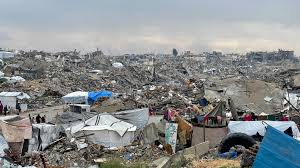
More than 90 percent of Gaza's school buildings have since been damaged or destroyed. At least 625,000 students have had no formal schooling. The university campuses are rubble. The libraries are rubble. And where the institutions once stood, education has taken a different shape.
In Khan Yunis, a teacher named Alaa Abu Mustafa lost her house to Israeli airstrikes. She set up a classroom in a tent. Not as a temporary fix while waiting for the schools to reopen. As the school. She gathered whatever children were nearby and started teaching.
That pattern repeated itself across the Strip. Communities did not wait for institutional permission. Makeshift classrooms appeared in tents, in damaged rooms, in corners of displacement camps cleared of rubble. Parents and teachers organized the lessons themselves. They had little to work with. UNICEF has reported that educational supplies are sitting blocked at the borders, not classified as sufficiently lifesaving to be admitted into Gaza. In some learning spaces, teachers write lessons on tent walls.
The Education Cluster, which coordinates humanitarian education response, has documented these initiatives and worked to support them where possible. UNICEF now runs more than 100 multi-service learning centers across Gaza, reaching roughly 135,000 children. Every single one has a waiting list.
What happens inside matters. These are not holding spaces. UNICEF describes them as places where children read, do math, and, equally, breathe. Mental health support is built in. The children who come have watched their schools be bombed, have been displaced eight or ten times within a strip of land twenty-five miles long, have spent months in tents through winter. Some have visible injuries. Many have ones you cannot see.
Palestinian writer Refaat Ibrahim, writing for Al Jazeera, described what the destruction of Gaza's education system means in terms that go beyond infrastructure damage. Before the war, he wrote, a poor child in Gaza could sit in the same classroom as a wealthy one. That is no longer true. The tent schools are not equally accessible. For the first time in many years, education has become something some families can reach and others cannot.
That is the quiet violence beneath the obvious one.
The numbers are still accumulating. A UN satellite assessment from mid-2025 found probable damage at 97 percent of school buildings across the Strip. The Education Cluster has been forced to scale back programs due to funding shortfalls. Gaza's GDP collapsed by 83 percent in the first year of the war. The infrastructure that made universal education possible, the supply chains, the institutions, the trained workforce, was not only bombed. It was strangled by a blockade that remains in place.
Against all of that, the tent schools exist. Teachers sitting with children on the ground. Teaching them to write when there are no walls to write on. It is not enough. It was never designed to be enough. But it is what education looks like when people refuse to wait for someone else to decide whether their children deserve it.
Gaza had built something careful and real over decades. Children heading to school together every morning. Universities running lectures in tents because the permanent buildings had not yet been completed. Communities pooling resources under occupation and blockade to keep classrooms open.
That inheritance is not gone. The tent is not the ending. But it is where things stand, and what comes next depends on decisions being made elsewhere, by people who are not sitting on the ground.