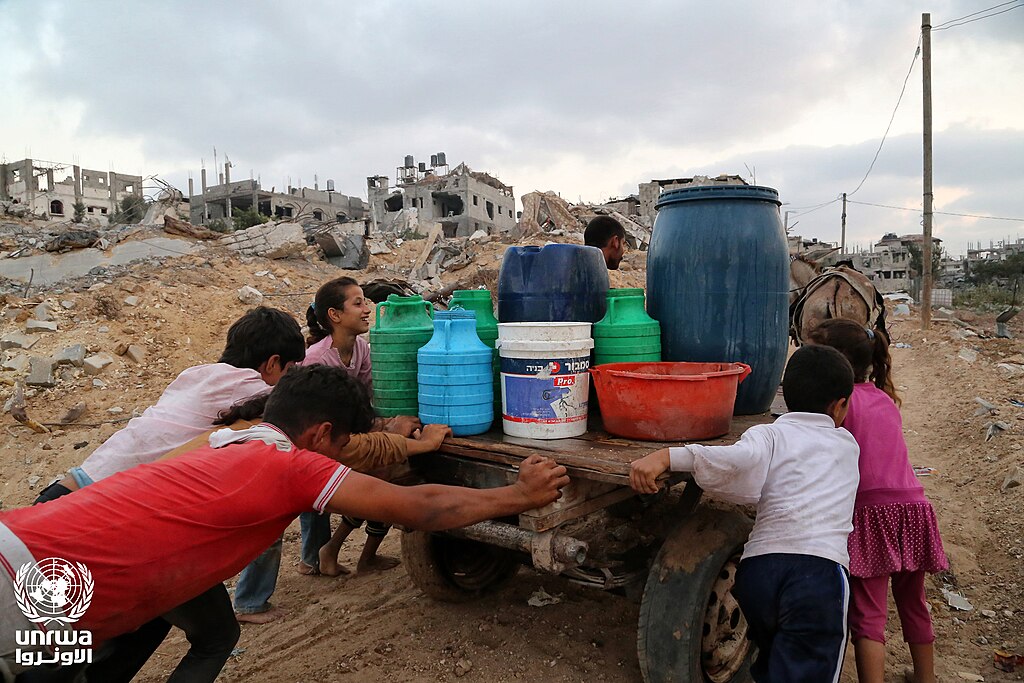
There is a game children play in Gaza. They call it "funerals."
One child lies still. The others carry him on their shoulders, walking in a line, chanting the words they have heard too many times at the graves of people they loved. Then the child gets up. They switch. Someone else lies down.
This is what play looks like when war is the only teacher a child has ever had.
A child born in Gaza in 2006 is nineteen years old today. In that time, they survived five full-scale military operations: 2008, 2012, 2014, 2021, and the war that began in October 2023 and has not stopped. Five wars. Not conflicts read about in a textbook. Wars that shook the walls of the room they slept in. Wars that took the people sitting beside them at the dinner table.
More than 17,000 children have been killed since October 2023 alone. UNICEF estimates that hundreds of thousands more are orphaned, separated from their families, or missing. Behind each number is a name. Behind each name is a face that once smiled at something small: a piece of candy, a cartoon, the sound of rain.
What war does to a developing brain
Researchers who study childhood trauma use the term "toxic stress." It describes what happens when a child's body is kept in a state of alarm for so long that the alarm becomes permanent. Cortisol floods the system. It rewires the brain. Sleep breaks. Memory fractures. Language sometimes disappears.
Studies from Gaza, conducted even before this current war, found that over 90% of children showed symptoms of post-traumatic stress. They startled at sounds that reminded them of airstrikes. They stopped talking. They drew pictures with no people in them. Just buildings with holes.
A child does not know that what is happening to them is called trauma. They only know that they feel afraid and that the fear does not go away when the noise stops.
One drawing
A psychologist working in Rafah described a drawing a seven-year-old boy made during a group session. He drew his house carefully: the door, the window, the small tree his father had planted in the courtyard. Then he drew a line through the roof. When asked what the line was, he said: "That is where the bomb came."
He drew his family standing outside. All of them. He drew his father too.
His father had been killed three months before.
The woman who taught children to speak through games
Nour is a child psychologist who works with a mobile mental health team operating out of a tent clinic in Khan Younis. She is twenty-six. She carries puppets in a canvas bag.
The puppets are simple: scraps of cloth sewn into figures, given names by the children who hold them. A puppet can say things a child cannot. A puppet can be angry, can cry, can ask where its mother is.
Nour says the children who come to her sessions rarely talk at first. They sit. They watch the puppets. Then, one day, one of them picks up a puppet and begins to speak. That is the moment. That is when she knows the work is reaching something real.
She runs the sessions while wearing a headlamp. There is no electricity.
What can be done
The psychological wounds of this war will outlast the war itself. A ceasefire does not undo what a child's nervous system has recorded. That work takes years, trained people, materials, space.
Yafa Relief funds child-friendly spaces where children can draw and move and be with peers in something that looks, briefly, like normalcy. We fund mobile psychological first aid teams reaching families who cannot travel to clinics. We fund art supplies, because a box of crayons is also a form of medicine.
Most humanitarian attention goes toward food and medical care, which are urgent and necessary. But the mind also needs tending. A child who survives physically but loses the capacity to trust, to sleep, to learn, to imagine a future is a child who has still been taken from themselves.
The bombs stop.
The war inside a child's head does not.
Not unless someone reaches in. Not unless there is a Nour with puppets in a canvas bag and a headlamp and enough belief left to run a session in a tent.
That belief can be funded. That work can be supported.
It is not too late for the children who are still alive.
[Donate to Yafa Relief's Child Mental Health Programs]