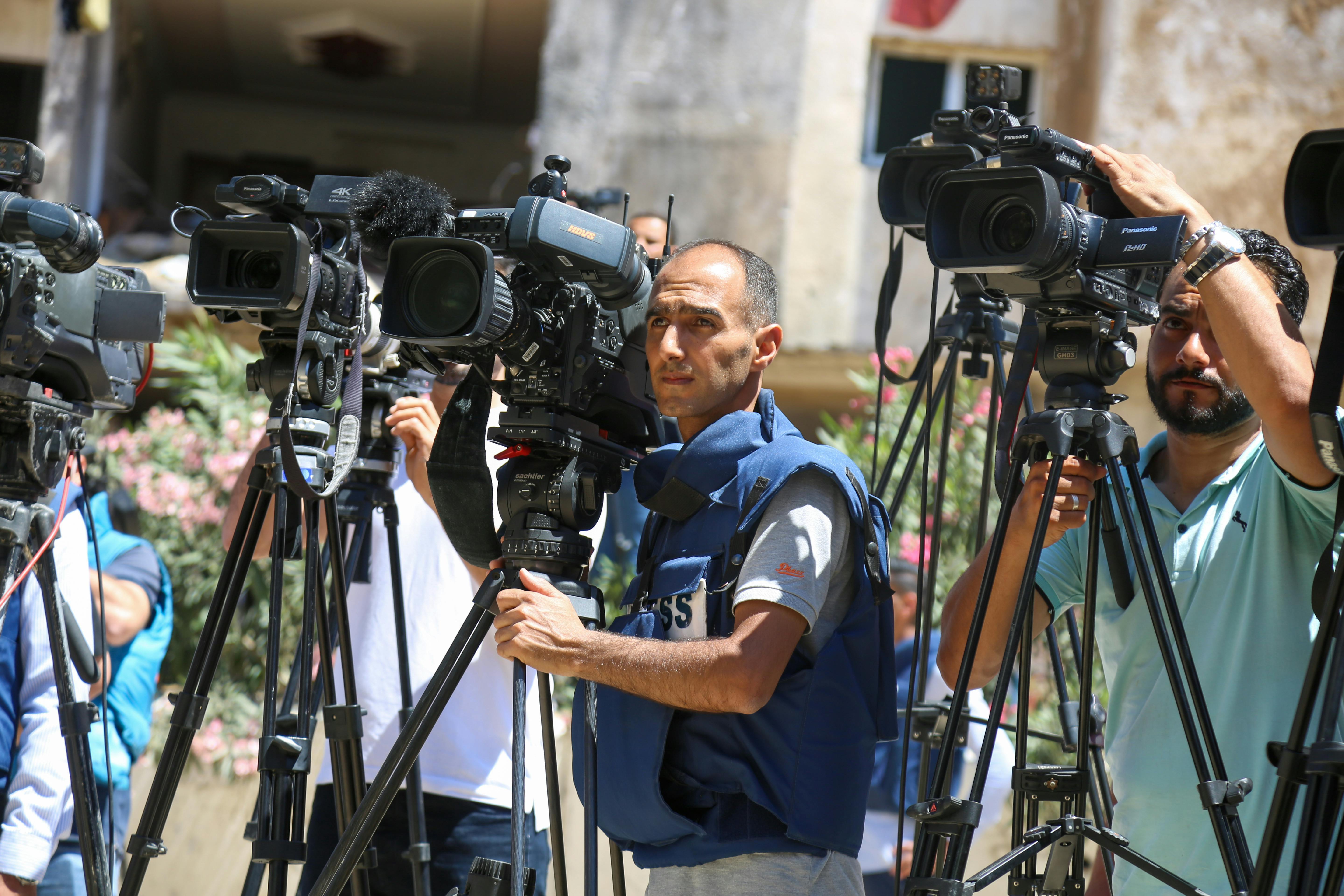
Editor's note: For two years, Israel has barred nearly all foreign journalists from independently entering Gaza. What you know about this war, the images, the names, the truth, has come through a small, decimated group of Palestinian reporters. They are not covering a conflict. They are surviving one.
WHY THESE JOURNALISTS MATTER
No foreign press. That has been the condition of knowledge about Gaza since late 2023, when Israel declared the Strip a closed military zone and locked out the BBC, CNN, Reuters, and every outlet unwilling to embed with Israeli forces and submit to military censorship before publishing.
The ground did not fall silent.
Palestinian journalists, already living under siege, picked up cameras and phones. They filmed their own neighborhoods being leveled. They reported from hospital floors where their own children lay dying. They became, by force and by choice, the world's only witnesses to what was happening.
The cost is not a figure you absorb quickly. Over 250 journalists and media workers have been killed in Gaza since October 2023, the highest concentration of journalist deaths in any conflict in recorded history. Of the 129 journalists killed worldwide in 2025, 86 died in Israeli strikes, most of them in Gaza. Two-thirds of all journalist deaths globally that year happened in one strip of land thirty-five kilometers long.
Zero foreign journalists. Hundreds of Palestinian ones. Dead.
THE ONES STILL REPORTING
Wael Al-Dahdouh did not stop.
Al Jazeera's Gaza bureau chief lost his wife, three children, a grandson, and then his eldest son, also a journalist, to Israeli airstrikes. He learned about his family while he was live on air. Viewers watched his face hold and then crack and then hold again. He was wounded twice. He reported from a wheelchair. When his cameraman Samer Abu Daqqa was killed beside him, he stayed on camera and described the blood on the ground.
"The most painful thing," he said, "was when a journalist ceased to be the one searching for the story and instead became the story."
He is still in Gaza. Still filing.
Bisan Owda ended nearly every dispatch the same way: "I am still alive." Her Emmy-winning work for AJ+ combined frontline urgency with something rarer, a sustained effort to archive Gaza's culture before it was gone. She filmed from rubble, from tents, from hospitals, always looking directly into the camera. Not performing grief. Witnessing.
Hind Khoudary was on air when an Israeli double-tap strike hit Nasser Hospital and killed the journalists around her. She stayed on. She later documented the return to northern Gaza after the ceasefire, walking through neighborhoods flattened to white dust and the smell of what had been there before.
"People walked for hours. They found nothing."
Motaz Azaiza built an audience of 17 million on Instagram while reporting from his own collapsing neighborhood. His captions were short. His images were not. He evacuated in early 2024 under direct threat, and has since raised over $60 million for aid inside Gaza through the Motaz Foundation.
"My life is worth more now than if I was dead. A lot of Gazans got killed. Nobody mentions their names."
Plestia Alaqad was 21 when the war began. She kept a diary for the first 45 days. It became a memoir, The Eyes of Gaza, now an international bestseller. She lives in Australia. She has not stopped writing about the place she grew up.
"My favorite thing about Gaza is the sea. It reminds you that everything will pass, even if it isn't easy."
Mohammed R. Mhawish reported on the ground for MSNBC and Al Jazeera before fleeing to the United States. He has since broken major stories on Israeli surveillance systems in Gaza and the deliberate targeting of civilian infrastructure. He is now a Knight Press Freedom Fellow at CUNY, training journalists who will go to the next place cameras are not allowed.
"I left Gaza, but Gaza never left me."
THOSE WHO PAID THE PRICE
Some names must be spoken.
Mariam Abu Dagga, a freelance photographer working with AP and Independent Arabia, was killed in a double-tap strike on Nasser Hospital. She was awarded a posthumous George Polk Award in 2026. Hossam Shabat, an Al Jazeera Mubasher correspondent, left a final message before he was killed: "If you're reading this, it means I have been killed. By God, I fulfilled my duty as a journalist." Samer Abu Daqqa, the Al Jazeera cameraman killed alongside Al-Dahdouh's team, died of his wounds while ambulances were denied access to reach him.
This list is not complete. It cannot be.
Israel has alleged that some of the dead had ties to militant groups. The Committee to Protect Journalists and Reporters Without Borders have found no evidence to support those claims for the journalists named here. The pattern of targeting journalists, their families, and their equipment is documented and consistent.
THE BLACKOUT
In April 2025, Israel formally banned Al Jazeera from operating in Israel and the West Bank, seizing equipment and blocking broadcasts. Over a thousand journalists from more than 60 countries, including Christiane Amanpour and Jeremy Bowen, signed a petition demanding unsupervised access. The Israeli government refused.
Al Jazeera's Gaza bureau continues to operate under fire.
The blackout is not incidental to this war. It is part of it. What cannot be seen cannot be mourned. What cannot be mourned cannot be stopped.
WHAT YOU CAN DO
Follow their work directly: Bisan Owda on Instagram and AJ+, Motaz Azaiza through the Motaz Foundation, Hind Khoudary on Al Jazeera English, Plestia Alaqad on Substack.
Support press freedom organizations: the Committee to Protect Journalists and Reporters Without Borders both provide direct assistance to journalists in Gaza, including emergency support and legal defense.
Demand access: share the petition signed by 1,000+ journalists, and write to your national broadcasters to ask why a complete press blackout has been treated as normal.
FINAL NOTE
These journalists did not choose to become the world's only witnesses. The choice was made for them, by a blockade and by the absence of anyone else willing to step in.
They filmed their homes being taken apart. They identified colleagues in the rubble. They kept recording.
The question is not what they owe us. It is what we have done with what they gave.