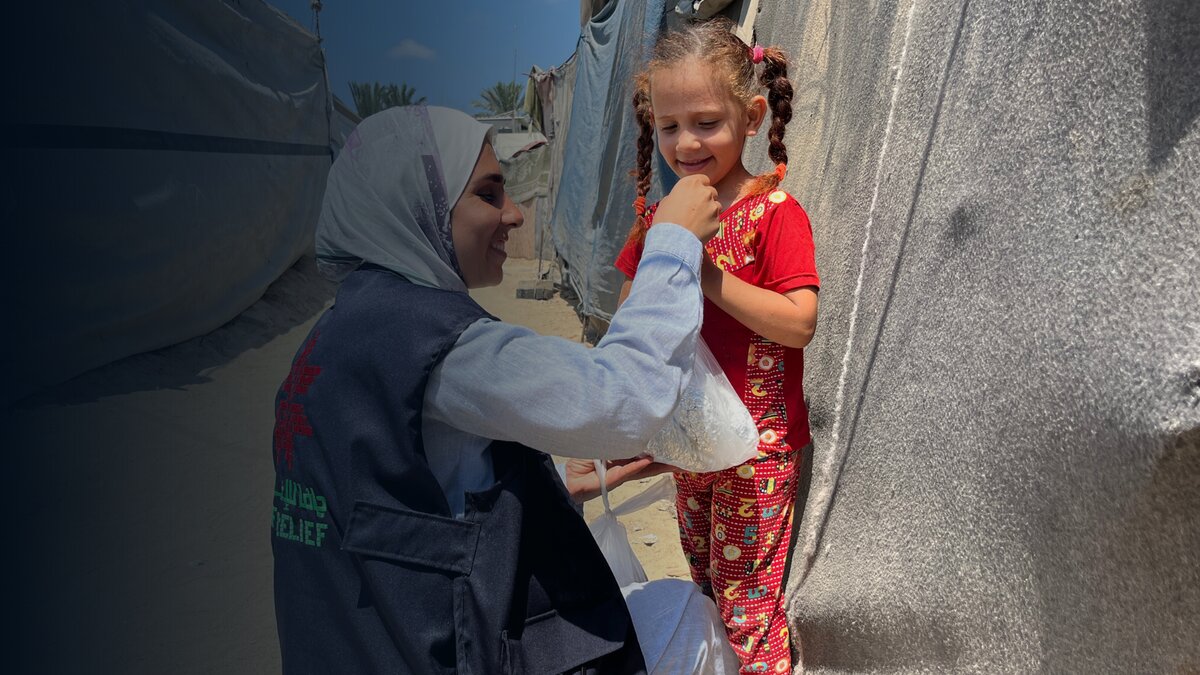
We want to start this issue with something that still hasn't fully sunk in for us.
Gaza did not fire a single shot in the Iran war. Hamas didn't officially declare involvement. No missiles from the Iran escalation landed in Gaza. And yet, the morning after the US and Israel launched strikes on Tehran, every border crossing into the strip was shut. No food. No medicine. Aid workers couldn't get in or leave.
The military operation was hundreds of miles away. The people paying the price were 2.1 million civilians who had nothing to do with it.
Israel's COGAT agency called the closures "necessary security adjustments." That phrase deserves more scrutiny than it's been getting.
The crossing that wasn't really open
By March 3, Israel announced a partial reopening. One crossing, Kerem Shalom, on the southern border, would allow "limited humanitarian cargo" in, "subject to security conditions."
One crossing. Limited cargo. Subject to conditions.
We're supposed to treat this as progress. But here's what was already happening before February 28, during what was supposed to be an active ceasefire: only 43% of planned aid deliveries were getting through. That's 260 trucks out of 600 planned, daily, even in relatively stable conditions. So the baseline that the partial reopening is returning us to was already a crisis. It wasn't some functional system that temporarily broke down. It was a restricted system being restricted further.
EUBAM Rafah, the EU monitoring mission at the Egypt-Gaza crossing, suspended all operations on March 2. The only crossing not directly under Israeli control was, for practical purposes, gone.
What World Central Kitchen actually told us
We're going to quote WCK's March 1 statement at some length here because it deserves to be read carefully, not summarized away.
"Food in Gaza depends entirely on daily shipments. What arrives today feeds people tomorrow. There is no surplus sitting in warehouses. There is no reserve to draw from. If food is not entering every single day, it simply runs out."
WCK had been cooking one million hot meals a day in Gaza. Not as a nice-to-have supplementary program. As the thing keeping a large portion of the population fed. And their inventory buffer, which was supposed to be seven days, had already been cut to two days before the closures hit, because of inconsistent truck flow from Egypt.
Two days of buffer. Then the crossings closed. By March 5, WCK paused meal distribution entirely.
Meanwhile, COGAT issued a statement saying existing food stocks would "suffice for an extended period." We're going to be blunt: that statement and WCK's ground-level operational reality cannot both be true. We know which one we believe, and we think you do too.
The numbers, because they matter
ACAPS, the independent humanitarian data organization, published an anticipatory analysis on March 5. It draws on OCHA data, IPC food security projections, and interviews with people actually inside Gaza. We'd encourage you to read it in full. Here's what the baseline looked like before the crossings closed:
89% of water and sanitation facilities in Gaza had been destroyed. 58% of health service points were nonfunctional. 81% of structures damaged. 77% of roads gone. Nearly half the population couldn't access the minimum 6 litres of drinking water per day. Over 101,000 children between six months and five years old were already acutely malnourished. At least 1.6 million people were projected to stay in Crisis food insecurity levels or worse through mid-April.
That's not a description of a recovering situation. That's what "ceasefire conditions" looked like in Gaza. And into that situation, on March 1, the crossings closed.
People in Gaza knew immediately what it meant. As soon as news of the Iran strikes broke, residents started hoarding flour, milk, and diapers. Prices spiked within hours. ACAPS field informants said that if closures lasted more than a few days, stocks would be gone within a week. For context on what a price spike looks like here: in August 2025, Gaza's Consumer Price Index was running more than 1,290% above pre-October 2023 levels. That's not a typo.
Ramadan. Again.
This one's harder to write about without getting angry, honestly.
WCK had just launched Ramadan food kit distributions. 100,000 kits, planned to produce 7 million meals across the holy month. That program is now paused.
For the second consecutive year, Ramadan in Gaza coincides with a supply crisis. Last year it was the full siege. This year it's the collateral fallout from a war in Iran. Different proximate cause. Same people going without food during the month when food and community are most central to daily life.
We don't think this is a coincidence in any conspiratorial sense. We think it's something more mundane and more troubling: the humanitarian system in Gaza has no buffer, no redundancy, and no protection from external shocks. One regional escalation, and a million meals a day disappear.
Who said what
The UN called for immediate reopening of the crossings. UNRWA Commissioner-General Philippe Lazzarini called it "a new chokehold on Gaza" and noted that people still lack basic supplies after two years of what he described as a man-made famine.
The EU condemned Iran's attacks in the region. A statement specifically addressing the Gaza crossing closures as a separate humanitarian emergency took notably longer.
The United States, which co-launched the strikes on February 28, had not issued a public statement addressing the humanitarian consequences of the resulting border closures at the time this newsletter went to press.
We're tracking all of this. Silence on a humanitarian consequence you helped trigger is itself a statement worth documenting.
The ceasefire promised this wouldn't happen
The October 2025 ceasefire agreement included a specific commitment to unimpeded humanitarian access. Between October 2025 and January 2026, the Gaza Government Media Office documented at least 1,244 ceasefire violations by Israel. The March 1 closures are one more entry on that list, distinguished mainly by the fact that the stated justification involves a military operation in a completely separate country.
The pattern is consistent. Commitments are made. Commitments are suspended when they become inconvenient. The people of Gaza have no mechanism to enforce any of it.
The Iran war didn't create this problem. It just made the machinery visible again.