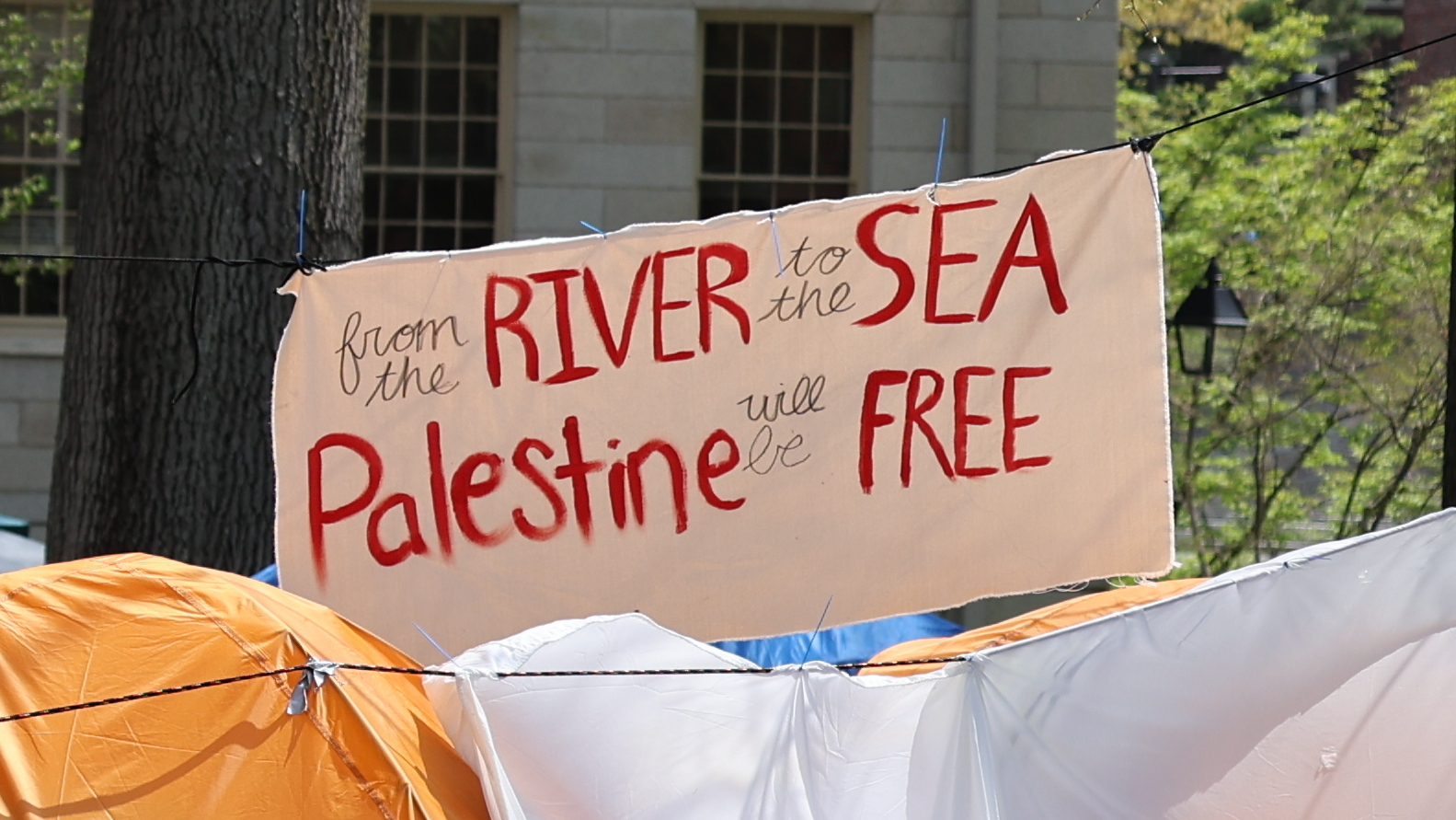
You've seen it on signs. You've heard it at protests. You've watched pundits argue about it for twenty minutes without anyone agreeing on what it even refers to.
"From the river to the sea, Palestine will be free."
Here is what the phrase actually means; geographically, historically, and politically; without the yelling.
Start with the map
The phrase describes a specific piece of land: the territory between the Jordan River to the east and the Mediterranean Sea to the west. That corridor, known as historic Mandatory Palestine, today includes the State of Israel within its pre-1967 borders, the West Bank, and the Gaza Strip. All of it. Every square kilometer in between.
That's the geography. The politics, predictably, get messier.
Where the phrase came from
The slogan does not appear in the PLO's original 1964 or 1968 charters. It was not coined by Hamas. It emerged in Palestinian nationalist discourse in the mid-1960s, adopted by the PLO as a shorthand for a unified, decolonized state over all of historic Palestine. By 1969, the Palestinian National Council was framing that vision as a "democratic secular state", equal rights for all residents, including Jews who rejected Zionism.
This is the part that tends to get lost.
The phrase predates its more militant uses by decades. It grew out of Palestinian resistance to partition, to the fragmentation of their homeland into occupied zones controlled by Israel, Jordan, and Egypt simultaneously. It was, at its origin, a call for political unity and self-determination across a geography that had been carved up by others.
There is also a parallel worth mentioning. In 1977, Israel's Likud party platform contained its own version: "Between the sea and the Jordan there will only be Israeli sovereignty." Both sides, it turns out, have reached for the same geography to make very different arguments.
How Hamas changed the conversation
Hamas's 2017 Document of General Principles uses the phrase explicitly: the organization rejects "any alternative to the full and complete liberation of Palestine, from the river to the sea." No ambiguity there. The same document also accepts, as a provisional measure, a Palestinian state on the 1967 borders with Jerusalem as its capital and the right of return for refugees. It maintains, in the same breath, a formal rejection of Israel's legitimacy as a Zionist entity.
That combination, liberation in principle plus provisional borders in practice, is not coherent to everyone. But it is what the document actually says.
October 7, 2023 collapsed whatever interpretive nuance the phrase still had for many people. Since then, the chant has surged globally, triggering bans and parliamentary debates across Germany, the UK, and the United States. Both the acceleration and the backlash tell you something.
Three ways to read six words
The academic consensus, such as it is, says the phrase is "open to an array of interpretations, from the genocidal to the democratic." That is not a dodge. It is a description of how language actually works when it travels across decades and movements.
Here are the three main readings.
For Palestinians and their supporters, the phrase asserts national rights across a homeland that was divided without their consent. "Free" in this reading means liberated from occupation, not emptied of people. Historians like Maha Nassar have emphasized that the Arabic phrasing, "Filastin hurra," means liberated Palestine, not "Palestine without Jews."
For Israeli and Jewish organizations including the AJC and ADL, the phrase denies Jewish self-determination and signals, in effect, the elimination of Israel as a Jewish state. When used by groups whose charters explicitly reject Israel's existence, the intent is not abstract. It reads as a call for erasure, whatever individual protesters may intend.
For academics working the middle ground, the meaning is inseparable from context. Who is saying it, in what setting, alongside which other slogans, and with what history attached? One slogan. Many meanings. None of them politically neutral.
What honest engagement looks like
The phrase is a Rorschach test for a conflict that has been running longer than most of its participants have been alive. Its origins are not what its critics say. Its uses are not what its defenders say. Both things are true.
Understanding the documented history does not require endorsing any particular outcome. It requires sitting with the fact that the same six words can express a democratic vision of coexistence or a call to erase a state, depending entirely on whose mouth they come from and what they mean by "free."
That ambiguity is not an excuse to stop thinking. It is the reason thinking is required.